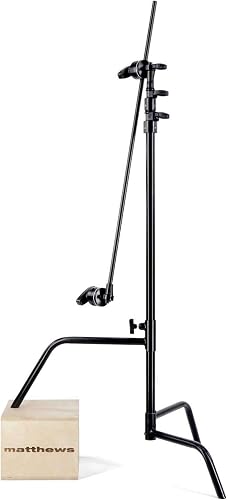
Part of our 18-stand C-stand package staged for a commercial shoot
If you're coming from a photography background or smaller-format video work, the grip department can look like an intimidating collection of metal things with mysterious names. C-stands, junior stands, baby pins, combo stands, gobo arms, turtle bases — and that's before you get to the flags, nets, silks, and diffusions that go on them.
Here's a practical breakdown of what actually matters, what you'll use constantly, and what only shows up on bigger productions.
C-Stands — The Foundation of Any Grip Package
The C-stand (Century stand) is the universal grip tool. It has three telescoping legs that stagger (so multiple stands can nest together in tight spaces), a riser column, and a gooseneck head that accepts a junior pin. The head rotates 360° and the arm can be extended to position flags, nets, lights, or bounce cards at almost any angle.
What makes C-stands specifically useful is the gooseneck knuckle — it lets you position a gobo arm precisely in 3D space rather than just raising and lowering a vertical column. You can fly a 4×4 flag directly over a window source at an angle, hold a reflector at exactly eye level, or suspend a small LED panel at a precise position that no other stand can replicate.
We carry 18 C-stands in our package — 10 tall (40") and 8 standard (20"). For a 2-camera commercial, that covers most setups without having to reposition constantly between shots.
When to Use a C-Stand:
- Mounting flags, nets, silks, and diffusion frames
- Holding small-to-medium LED panels (up to 600d Pro with proper arm)
- Positioning bounce cards and reflectors
- Any situation where you need the arm to extend over the subject or light
Baby Stands — Simple, Light, Fast
A baby stand is what it sounds like: a lightweight tripod with a 5/8" baby pin at the top. No arm, no gooseneck, just a fixed pin at whatever height you set it. They're faster to set up and break down than C-stands, and they're the right tool when you just need a light at a specific height and don't need arm positioning.
We carry a range of baby stands that work with our Amaran units for fill, background, and hair lighting where the C-stand geometry would be overkill.
Apple Boxes — More Important Than They Sound
Apple boxes are solid wooden boxes (full, half, quarter, pancake) that look deceptively simple but are among the most-used items on any set. They're load-bearing seats for talent adjustments, risers for props and product, camera dollies for low-angle moves, stabilizers for uneven ground, and a hundred other things that grip and art department solve with them in real time.
We carry full sets. Don't leave them off your order thinking you won't need them — you will use every one.
Roller Stands — When You Need Height and Reach
Our 8' roller stand is a wheeled, high-rising stand designed for studio or interior work where you need to get a light overhead without rigging it to a ceiling grid. It's the right call for a 600d Pro overhead in an interior location where the ceiling is too low for a proper overhead rig and too high for a standard C-stand to reach effectively.
For Florida exteriors: Always sandbag your C-stands. Wind is unpredictable on Treasure Coast locations — especially on the beach — and an unsandbagged C-stand with a flag arm is a liability. We include sandbags with the package.
What You Can Skip on a Smaller Package
Not every shoot needs 18 C-stands and an overhead kit. For a 1-camera interview or simple documentary setup, you might only need 4–6 C-stands and a smaller light kit. Our quote form lets you specify individual items so we can build the right package for your specific day rather than defaulting to the full 2-ton.
Build the right grip package for your shoot
Tell us your setup and we'll configure the right gear — no minimums, no boilerplate packages.
Get a Quote